Diana Mosquera, Executive Director at Diversa
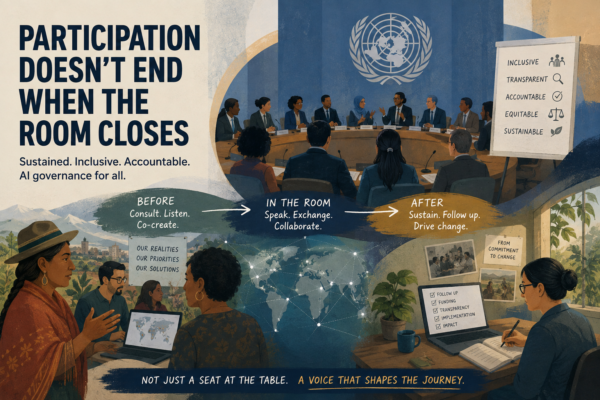
At the close of the first United Nations Global Dialogue on AI Governance (UNGDAI) in Geneva, I was left with one question: what does it really mean to participate in global AI governance? Being in the room and taking the floor are important steps, but participation begins long before and must be sustained afterward.
I write from Ecuador, from Diversa, a Latin American organization working on research, technological development, training, and AI governance from a critical perspective. Our work connects international debates with the realities of those who experience the effects of these technologies in very different ways: academia, civil society, those who supply the raw materials, and local communities. For us, participation is not just about being invited to a conversation: it is about shaping how problems are defined and decisions are made.
Our ask
The first UNGDAI did not begin the day the doors to the room opened. Over the preceding six months, thematic, regional, and virtual consultations were held, and more than 1,500 contributions were received from governments, civil society, businesses, academia, and the technical community. That diversity of actors at the table is exactly what we need: AI is already shaping public, economic, and social decision-making, and broad consultative processes can translate that urgency into concrete action.
Our ask to UNGDAI is that this consultation process not remain merely symbolic, but become the starting point for a permanent participation infrastructure: agendas and documents published well in advance, regional and multilingual consultations between sessions, funding to enable organizations with fewer resources to sustain their participation, and channels for those unable to travel. Only then can the process produce verifiable results, rather than become just another event on the international calendar.
What worked in Geneva
As is often the case at these kinds of gatherings, the richest exchanges did not always happen in the plenary sessions, but in the side events. That is where it was possible to engage more directly, sit down at smaller working tables, and take a closer look at projects from different regions that are already building more participatory models of governance. That diversity of initiatives, many of them led from the Global South, showed that there is already a base of knowledge and practice for UNGDAI to build on and sustain over time.
Initiatives such as MAP-AI, a project launched in 2025 by the Global Network Initiative (GNI) and the Centre for Communication Governance (CCG) at National Law University Delhi to strengthen multistakeholder participation in AI governance, and in which Diversa participates, are part of the continuity infrastructure that is currently missing: spaces that sustain regional conversations and connect them to global processes beyond a single gathering.
After Geneva, and in parallel
I had the honor of speaking on the “AI Opportunities and Implications” panel at UNGDAI, a session that brought together heads of state, ministers, government delegations, and international organizations to discuss how to build AI governance capable of addressing today’s social, economic, ethical, cultural, linguistic, technical, and environmental challenges. It was a concrete opportunity to bring the voice of Latin America and the Global South into a conversation in which today’s decisions will shape the future development of these technologies.
That same week in Geneva, other processes were taking place in parallel, including the AI for Good Summit and the WSIS Forum. This overlap of agendas also raised questions that I think are important to address. At various AI for Good side events, civil society organizations such as Access Now, through their discussion space “Not AI for Good”, raised questions about the coherence of these spaces, considering the role of some participating companies in contexts of armed conflict and their impact on human rights.
These are legitimate institutional questions about coherence: no use of AI can credibly be presented as ethical or humanitarian without considering the broader human rights implications associated with the companies involved.
What remains to be deliberated
These intersections between UNGDAI, AI for Good, and WSIS show that the fragmentation of the AI governance ecosystem is not just a technical problem, but also an economic, ethical, and political one. Looking ahead to the intersessional work, I would like to see UNGDAI engage more deeply with two questions: how to prevent participatory governance forums from becoming showcases that legitimize actors who are not held accountable for the broader impacts of their technologies; and how to ensure that Global South representation translates into real influence rather than merely symbolic presence.
The success of UNGDAI should not be measured by how many countries, sectors, or people were represented in Geneva, but by its capacity to sustain the process, maintain coherence between principles and practice, and translate participation into decisions that genuinely respond to those who bear the greatest risks associated with these technologies.